
Practice questions· 12 min read
ISA Arborist Exam Questions: 10 Sample Questions with Answers
10 exam-style ISA arborist exam questions, one from each domain, with answers and explanations. See how the exam asks questions and where to practice more.
By PassArborist Editorial Team

Key takeaways
- ISA does not publish its exam questions. The 10 below are exam-style questions written for practice, one from each of the 10 exam domains, each with the answer and an explanation.
- Every ISA question has four options and one correct answer. The exam has 200 questions, and 20 of them are unscored pretest items you cannot tell apart from the rest.
- Safe Work Practices (15%) and Pruning (14%) carry the most questions, about 30 and 28 of the 200.
- For more, the free 20-question practice test and the PassArborist app have exam-style questions across all 10 domains, all with explanations.
ISA arborist exam questions are not published: ISA keeps its item bank private and doesn’t release past exams. What it does publish is the format (200 multiple-choice questions, four options, one correct answer) and the share of the exam each of its 10 domains takes. Below are 10 exam-style questions, one per domain, each with the answer, an explanation and a note on the wrong option most people pick.
The questions come from the PassArborist question bank. They are written against ISA’s published exam outline for practice, not taken from ISA.
How ISA arborist exam questions work
Every question on the ISA Certified Arborist® exam has four answer choices and exactly one correct answer. There are 200 questions in total. Twenty of them are pretest items ISA is trying out for future exams: they don’t count toward your score, and nothing marks them, so you answer every question as if it counts.
The number of questions from each domain follows its weight in the ISA exam outline. Safe Work Practices is 15 percent of the exam, so expect about 30 safety questions; Urban Forestry is 6 percent, about 12.
The outline also lists the tasks each domain tests, written as things an arborist does: “Explain why pruning is undertaken”, “Perform a limited visual tree risk assessment”, “Develop and implement tree protection plans”. So expect two kinds of question: ones that check a term or a fact, and ones that describe a situation and ask what it means or what you would do.
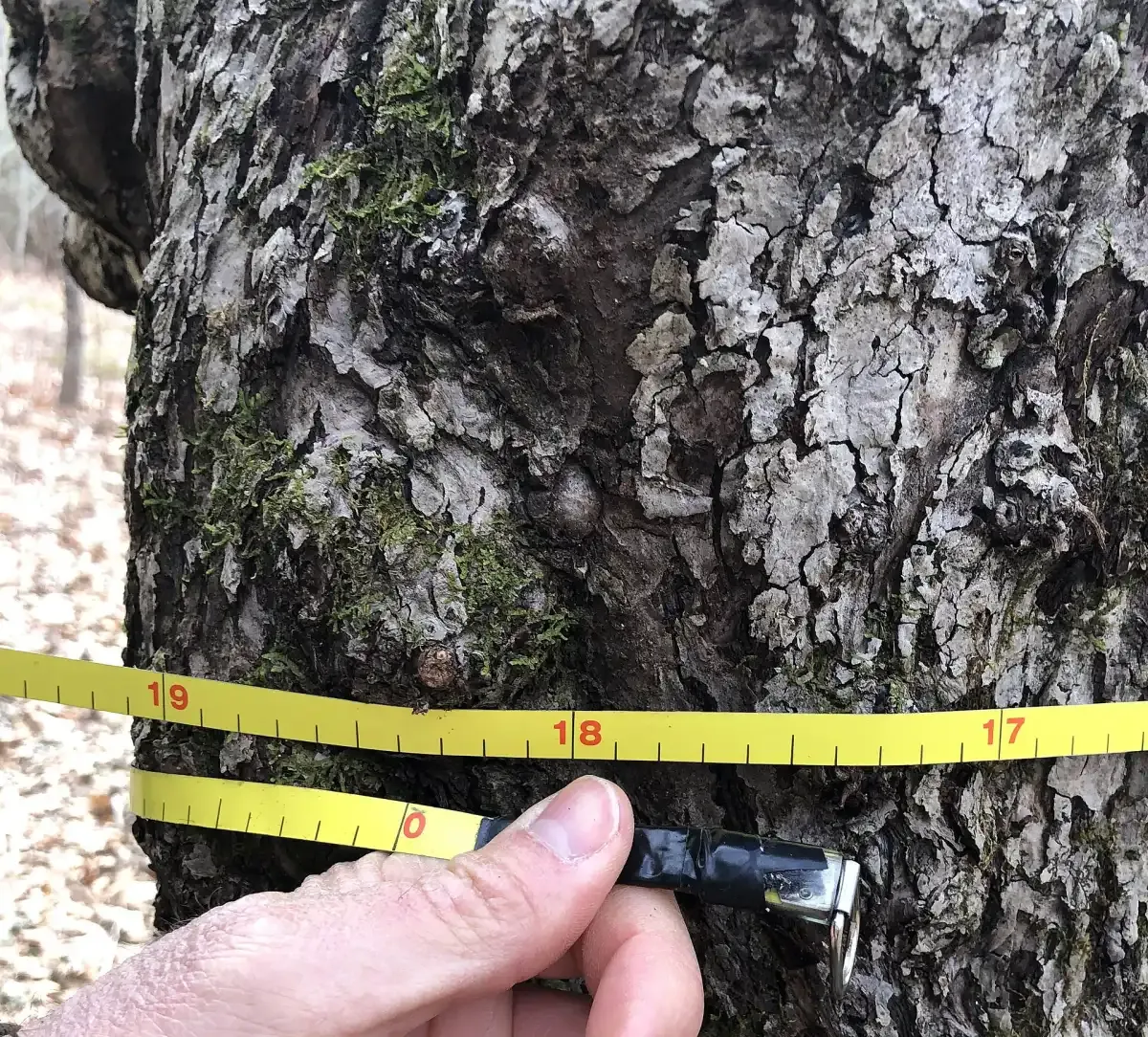 Photo: National Park Service, via Wikimedia Commons (public domain).

For format, fees, scoring and test-day rules, see the ISA Certified Arborist exam guide.
10 sample ISA Certified Arborist exam questions
The domains are in the order ISA lists them. Pick an answer before you open “Show answer”.
Tree Biology (11%)
Anatomy and physiology: roots, wood, water and sugar transport, growth stages, and how trees respond to wounds and stress.
According to the CODIT model, which wall is considered the strongest barrier to the spread of decay?
- Wall 1, which resists the vertical spread of decay
- Wall 4, the barrier zone
- Wall 2, which resists inward spread
- Wall 3, which resists lateral spread
Show answer
B. Wall 4, the barrier zone
Walls 1 to 3 are chemical and anatomical changes in wood that already existed when the tree was wounded. Wall 4 is different: the cambium lays down new wood after the wound, and that layer separates the injured wood from everything that grows afterwards. Because it is a new, physically distinct layer, it holds decay back best.
Why not Wall 1: it is the weakest of the four. Vessels and tracheids run up and down the stem, so decay spreads vertically more easily than in any other direction.
Tree Identification and Selection (9%)
Identifying trees by leaves, twigs, bark, flowers and fruit, using scientific names, and choosing the right species for a site.
Which of the following species is classified as a deciduous conifer?
- Eastern hemlock
- Arborvitae
- Larch (Larix spp.)
- Eastern redcedar
Show answer
C. Larch (Larix spp.)
Larches are conifers that drop all their needles in fall, after they turn yellow. The other deciduous conifers you are likely to meet are baldcypress (Taxodium) and dawn redwood (Metasequoia).
Why not eastern redcedar: it is a juniper (Juniperus virginiana) and keeps its foliage year-round, like hemlock and arborvitae. The bronze color some redcedars take on in winter is not leaf drop.
Soil Management (7%)
Soil texture, structure and chemistry, nutrients and pH, soil volume, compaction and how to fix it.
A tree in alkaline soil showing interveinal chlorosis on young leaves is most likely deficient in:
- Iron (Fe)
- Nitrogen (N)
- Phosphorus (P)
- Calcium (Ca)
Show answer
A. Iron (Fe)
At high pH, iron forms insoluble compounds the roots can't take up, even when there is plenty of it in the soil. Iron doesn't move easily within the tree, so the newest leaves show it first: yellow tissue between green veins. Pin oak and red maple on alkaline sites are the classic examples.
Why not nitrogen: nitrogen is mobile in the tree, so a shortage shows up as an even yellowing of the older leaves first, not a vein pattern on new growth.
Installation and Establishment (9%)
Planting and transplanting to industry standards, then watering, mulching and early care until the tree is established.
Which of the following is a sign of excessive planting depth?
- Root flare clearly visible at the soil surface
- Foliage that is darker green than normal
- Abundant epicormic sprouts on the lower trunk
- Soil over the root flare, trunk taper not visible, and chronic decline
Show answer
D. Soil over the root flare, trunk taper not visible, and chronic decline
A tree planted too deep goes into the ground like a fence post: no flare, no taper. The buried roots sit in soil with less oxygen, and the problem shows up as slow decline over several years rather than right away. Digging down to the first main root confirms it.
Why not epicormic sprouts: they follow many kinds of stress, from heavy pruning to root damage, so on their own they don't point to planting depth. A clearly visible root flare is what correct depth looks like.
Pruning (14%)
Why trees are pruned, pruning objectives and types of cuts, tools, and practices that harm trees, such as topping.
Which cut is made first in the three-cut method for removing a large branch?
- A top cut that severs the branch cleanly
- A partial undercut on the underside of the branch, away from the trunk
- A final cut just outside the branch collar
- A cut at the midpoint of the branch to reduce weight
Show answer
B. A partial undercut on the underside of the branch, away from the trunk
The undercut goes in first, some distance out from the trunk. The second cut comes from the top, a little farther out, and drops the limb. If the limb starts to fall early, it breaks at the undercut instead of peeling a strip of bark down the trunk. The third cut removes the stub.
Why not the cut just outside the branch collar: that is the right place for the final cut, but it comes last, once the weight is off. Made first on a heavy limb, it is the cut most likely to tear bark below the collar.
Diagnosis and Treatment (9%)
Diagnosing pests, diseases and abiotic disorders, plus plant health care (PHC) and integrated pest management (IPM).
Which of the following is a characteristic sign of Armillaria root rot?
- Orange, jelly-like galls on cedar branches
- Black, sooty coating on leaf surfaces
- White mycelial fans under the bark at the root crown
- Sunken, target-shaped cankers on the trunk
Show answer
C. White mycelial fans under the bark at the root crown
Peel back the bark at the root collar of a tree with Armillaria and you often find fan-shaped sheets of white mycelium. Black, bootlace-like rhizomorphs and clusters of honey-colored mushrooms at the base in fall are other signs of the same fungus.
Why not target-shaped cankers: those are typical of canker fungi such as Nectria on the stem. Armillaria works in the roots and root collar, which is why you look below ground level.
Trees and Construction (9%)
Tree protection plans for building sites, how construction damages roots and stability, and treating trees after the work.
Which of the following accurately describes the difference between a CRZ and a TPZ?
- The CRZ is calculated from DBH and defines the biologically critical root area; the TPZ is the protection area set for construction, which may be larger
- CRZ and TPZ are interchangeable terms for the same protective area
- The TPZ is calculated from DBH; the CRZ is the regulatory zone defined by local ordinance
- The CRZ is used in the United States; the TPZ is used only in the United Kingdom
Show answer
A. The CRZ is calculated from DBH and defines the biologically critical root area; the TPZ is the protection area set for construction, which may be larger
The critical root zone is a quick formula, commonly 1 foot of radius for every inch of trunk diameter. The tree protection zone is a site decision: it is at least as large as the CRZ and grows for species that tolerate root loss poorly, for older trees and for trees in poor condition. You can work both out with the DBH and critical root zone calculator.
Why not "interchangeable": plenty of specs and job sites use the two terms loosely, but the exam treats them as different things with different purposes.
Tree Risk (11%)
Who is responsible for what in tree risk management, the types of tree risk, and limited visual assessments of trees near targets.
A tree risk assessor uses the term "target occupancy" to describe:
- How much of the canopy overhangs a target area
- The number of different types of targets beneath a tree
- Whether the target is movable or fixed in location
- How frequently and for how long people or property are present in the target zone
Show answer
D. How frequently and for how long people or property are present in the target zone
Occupancy is rated from rare to constant. A bench that someone sits on most afternoons has a higher occupancy than a service road used twice a week. It feeds the likelihood that a failed part would actually hit something, which is then combined with the likelihood of failure and the consequences to reach a risk rating. The target zone itself is usually set from the tree's height; the tree height calculator shows the 1× and 1.5× distances.
Why not movable or fixed: that matters when you choose mitigation (you can close a path or move a picnic table), but it says nothing about how often a target is there.
Safe Work Practices (15%)
Safety standards and regulations, PPE, electrical hazards, climbing, rigging, tree removal and emergency response.
The "working load limit" (WLL) of a rigging component is defined as:
- The maximum force a component can sustain before permanent deformation occurs
- The maximum load a component should be subjected to in normal use, typically a fraction of the breaking strength
- The tensile strength of the component when new and undamaged
- The rated load for a component when used in a 2:1 block and tackle system
Show answer
B. The maximum load a component should be subjected to in normal use, typically a fraction of the breaking strength
Manufacturers divide the minimum breaking strength by a design factor to get the WLL. The margin covers shock loading, wear, knots and bends, and everything else that weakens gear in real use. In tree rigging, a piece that drops even a short distance before the line catches it can load the system far beyond its weight, which is why you estimate the piece first (the log weight calculator helps) and stay under the WLL of every component.
Why not the strength when new: that describes the minimum breaking strength. The WLL is always lower, by design.
Urban Forestry (6%)
The benefits of urban trees, plant appraisal, tree inventories and management plans, and working with the public.
Which of the following is a limitation of using DBH as the primary metric in an urban tree inventory?
- DBH is difficult to measure accurately in the field
- DBH measurements change dramatically with seasonal moisture
- DBH alone does not capture canopy condition, structural integrity or ecosystem service value
- DBH cannot be used to estimate tree height in urban settings
Show answer
C. DBH alone does not capture canopy condition, structural integrity or ecosystem service value
DBH is a good stand-in for size and age, which is why every inventory records it. But two trees with the same DBH can be a healthy shade tree and a hollow one with half a crown. A useful inventory adds fields for condition, defects, maintenance needs and site, so the data can drive a work plan.
Why not "difficult to measure": DBH is one of the easiest and most repeatable measurements in the field, a tape at 4.5 feet (the DBH calculator converts circumference). Its limit is what it leaves out.
How did you do?
Ten questions can’t tell you whether you’ll pass. The exam has 180 scored questions, and ISA’s passing score is 76 percent of them, so one short quiz is far too small a sample to predict a result.
What a short set can show you is where to look. If you missed the soil or the urban forestry question, that domain probably deserves a closer read, whatever your total. A mistake on a definition you thought you knew is a better signal than a lucky guess on one you didn’t.
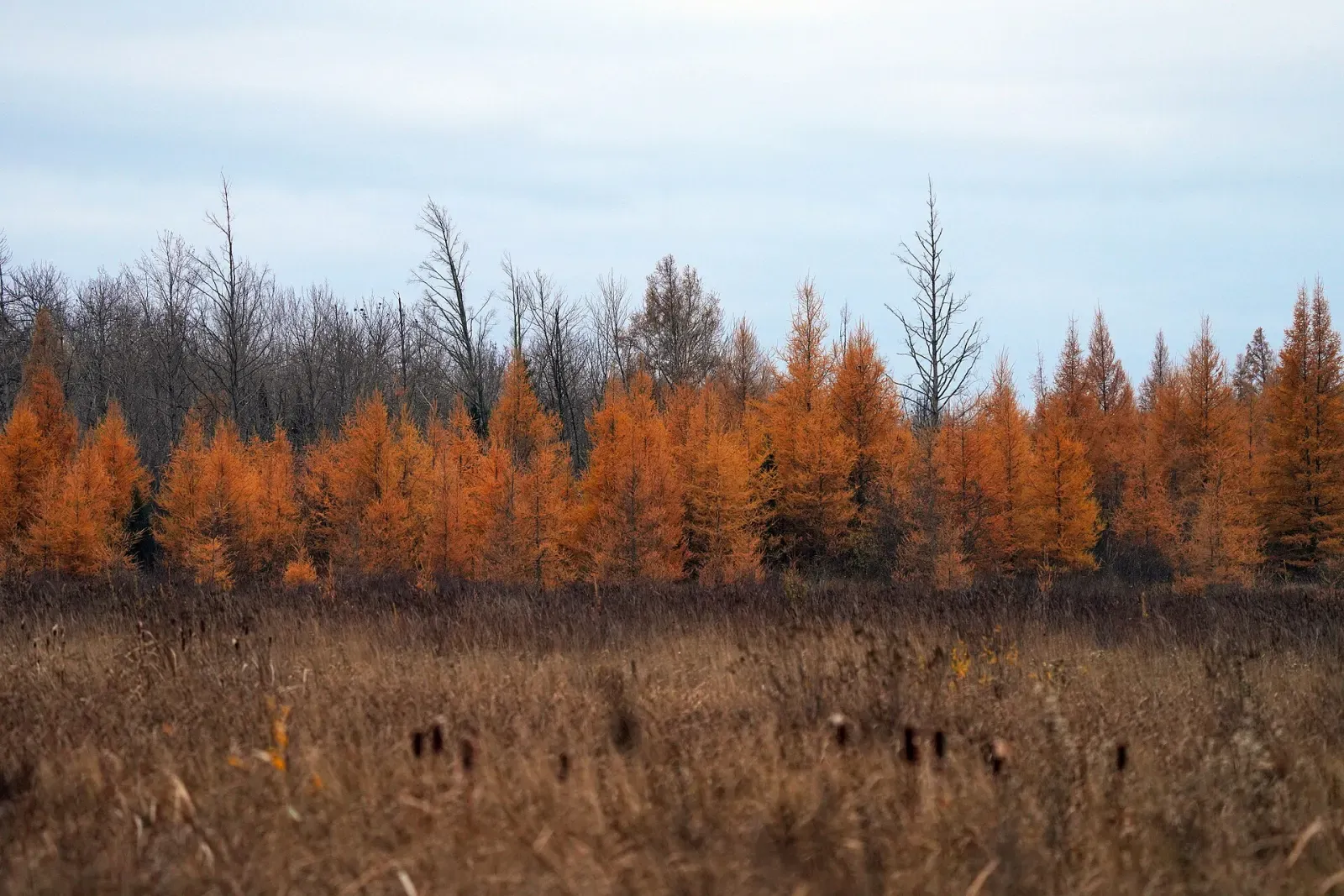 Tamaracks, the larch from question 2, just before they drop their needles. Photo: Courtney Celley, U.S. Fish and Wildlife Service, via Wikimedia Commons (public domain).

For a better read, take the free 20-question ISA arborist practice test. It covers all 10 domains, weighted like the real exam, and explains every answer. Before test day, sit at least one full-length, 200-question practice exam: it shows which domains drag your score down and how your focus holds up over 3.5 hours.
How to get more out of practice questions
- Count only your first attempt. The second time through, you remember the answer, not the reason, and the score flatters you.
- Read the explanation even when you got it right. Some right answers are partly guessed. The explanation tells you whether you actually knew it.
- Track misses by domain, not as one score. “72 percent” tells you little. “Missed 5 of 8 in Soil Management” tells you what to read tonight.
- Come back to missed questions after a few days. Retrying straight away tests short-term memory. A gap of a few days tests whether it stuck.
- Mix the domains once you’ve covered each one. The real exam doesn’t group questions by topic, so you have to switch from rigging to soil chemistry and back.
- Time yourself on a full set at least once. Two hundred questions in 3.5 hours is about a minute a question, with some time to review.
Where to find more ISA arborist practice questions
- The free ISA arborist practice test on this site: 20 questions across all 10 domains, with an explanation for each answer. No sign-up.
- ISA’s own practice exams: ISA sells the Arborists’ Certification Practice Exam, a 200-question online exam, and Practice Exams 2, 3, 4 and 5, each with different questions. ISA credential holders can also earn CEUs by completing them. Details are in the ISA Newsroom.
- The PassArborist app: 963 exam-style practice questions across all 10 domains, each with a written explanation, plus 200-question mock exams, 286 key-term flashcards and an AI tutor that explains any answer and takes follow-up questions. It’s free on the App Store.
One warning: ISA does not release its exam questions. Files sold or shared online as “the real ISA exam” or as exam “test banks” are not ISA’s items, and they won’t show you what’s on your exam.
Frequently asked questions
Are these real ISA exam questions?
No. They are exam-style questions written for practice against ISA’s published exam outline. ISA does not publish or release its exam questions.
How many questions are on the ISA Certified Arborist exam?
200 multiple-choice questions, each with four options and one correct answer. 20 of them are unscored pretest questions, so 180 count toward your score. The exam guide covers format, fees and scoring.
Does ISA have an official practice exam?
Yes. ISA sells the Arborists’ Certification Practice Exam, a 200-question online exam, plus Practice Exams 2, 3, 4 and 5 with different questions.
What kinds of questions are on the ISA arborist exam?
Multiple-choice questions across 10 domains, from tree biology to urban forestry. Some check a term or a fact, such as a species, a part of the tree or a safety rule. Others describe a field situation and ask you to diagnose it or choose the right action under industry standards.
Which domains have the most questions?
Safe Work Practices (15%) and Pruning (14%), then Tree Biology and Tree Risk (11% each). On a 200-question exam that is about 30, 28, 22 and 22 questions.
Is there a free ISA arborist practice test?
Yes. The free ISA arborist practice test on this site has 20 questions across all 10 domains, weighted like the exam, with an explanation for every answer.
Written by
PassArborist Editorial Team
The team behind PassArborist, the ISA arborist exam prep app. Questions or corrections? Contact us.